

Readiness Roadmap: ECM and Community Supports Providers
Deciding to join the Medi-Cal transformation journey as a contracted provider requires thoughtful planning and consideration. This Readiness Roadmap helps break down the steps along this implementation journey with vetted tools and resources from peers and experts across the state who have embarked on the journey as well.
Learn more about PHIL’s work supporting the CalAIM PATH Collaborative Planning and Implementation (CPI) initiative, serving Del Norte, Humboldt, Lake, Marin, Mendocino, Napa, and Sonoma counties.
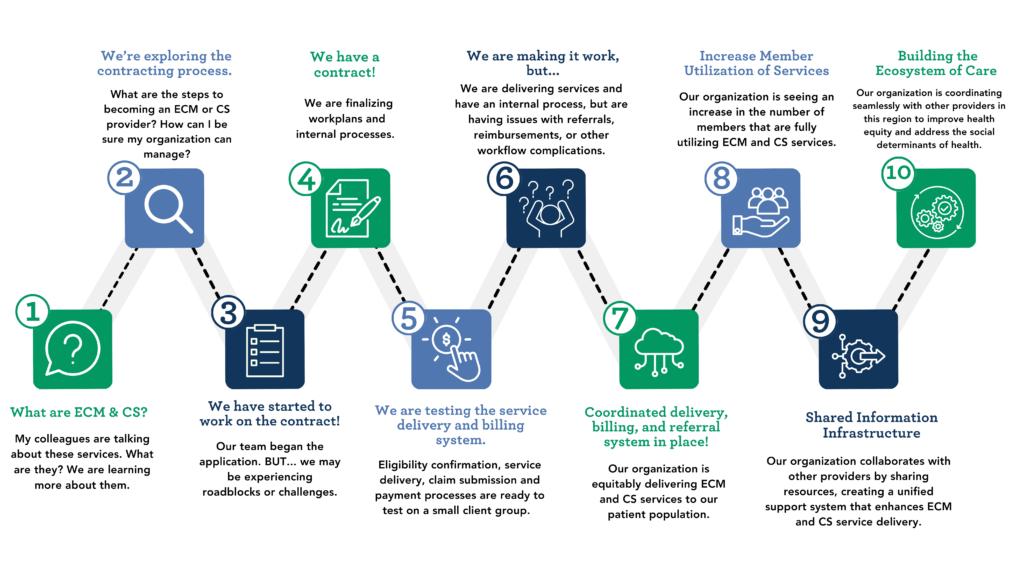

Phin Tip: Not sure where to start? Find the stage below that best matches your organization’s contracting journey, then expand that section to discover recommended resources, tools, and next steps.
Pre-Contracted Tools and Solutions
Expand each section below to access additional guidance, resources, and helpful links.
Step 1. What are Enhanced Care Management (ECM) & Community Supports (CS)?
▶ A. Learn
Explore these resources as you begin to understand CalAIM:
- CalAIM 101 Education Toolkit
- DHCS CalAIM Initiatives Main page
- DHCS Standard Terms
▶ B. Connect
Connect with your MCP representative to learn more about the needs and opportunities to provide services in your county.
- Find the Managed Care Plans in your county
- Each MCP website will have a page and contact information specific to CalAIM services. For example: L.A. Care Enhanced Care Management
- For Information specific to Providers: DHCS Managed Care Links for Providers
Check out your local MCP’s provider directory and connect with a local peer already providing services to learn more about CalAIM.
- Example 1: Partnership Health Plan Provider Directory and Video Walkthrough
- Example 2: Kaiser Permanente Provider Directory and Video Walkthrough
▶ C. Access
Explore these self-assessment tools to help decide about moving forward towards contracting:
- “To CalAIM or Not to CalAIM? The Question Every Community-Based Organization is Asking”
- A guide for CBO considerations (Public Works Alliance and the Justice Serving Network)
- Partnership Assessment Tool for CBO/Health
- Resources for New CalAIM Providers
Step 2. We’re exploring the contracting process.
▶ A. Understand the Contracting Pathway
Before submitting an interest statement to the MCP it’s important to get a general understanding of the organizational requirements that are a part of becoming a Medi-Cal provider.
- Medi-Cal Managed Care 101 for Community Supports Providers
- Medi-Cal Managed Care 101 for ECM Providers
- CalAIM Budget Estimator Tool and Training Demonstration
- GET READY: A Contracting Best Practices Guide for Becoming a Medi-Cal Community Supports Provider
- Building the value case for complex care: Business Planning
- California Community Supports Pricing Resource
▶ B. Estimate Costs
Start to estimate the costs and return on investment of becoming a contracted provider using the following tools:
- Braiding Medicaid Funds to Support Person-Centered Care: Lessons from Medi-Cal
- Balancing Funding and Implementation Mapping
- Contracting to Align Health and Social Care Ecosystems: A Toolkit Sharing Leading Practices
▶ C. Explore Additional Opportunities and Resources
Check out examples of collaborative implementation and funding strategies from other providers and connect with others already doing it in your area!
Step 3. We have started to work on the contract!
▶ A. Become a “Provider“
Obtain a National Provider Identifier number (NPI) using this tool:
- National Provider Identifier Application
- National Provider Identifier (NPI) Application: A Step-by-Step Guide for Providers Participating in the ECM and Community Supports Programs
▶ B. Initiate Contact with MCP
Contact your local Managed Care Plan(s) (MCP) representatives to express interest as new providers in contracting for the services that are appropriate to your organization, request a readiness assessment, and discuss any questions on the contracting process.
▶ C. Determine Rates and Contracts
Reference the initial self-assessment (from Step 1C) that your organization conducted.
Work with your MCP to negotiate a rate that will sustain programming.
- Note: Some MCPs use a uniform fee schedule for all providers
Post-Contracted Tools and Solutions
Expand each section below to access additional guidance, resources, and helpful links.
Step 4. We have a contract!
▶ A. Learn the Service and Delivery Landscape
Explore these resources to support your implementation work:
- Operation and Service Delivery
- Enhanced Care Management & Community Supports Policies and Resources
- Financial Considerations
- Claims Analysis Template
- Revenue Cycle Presentation Part 1
- Revenue Cycle Presentation Part 2
- Beyond the Grant: A Sustainable Financing Workbook
- California Community Supports Pricing Resource
- Justice-Involved Billing Toolkit
▶ B. Connect with Your Peers
Participate with other providers in the area for best practices and tips and stay connected through local collaboratives of providers, such as:
- Community Information Exchange
- Accountable Communities for Health
- Other local cross-sector facilitators
Step 5. We are testing the service delivery and billing system.
▶ A. Understand the Member Network and MCP Referrals
Contact your local MCP(s) representative to request eligible ECM or Community Supports member lists and discuss MCP referral opportunities outside your current clients.
▶ B. Get Support on the MCP Authorization Process
Starting out in the process of submitting Treatment Authorization Requests (TARs) can take some time to figure out. Reach out to your MCP for support and ask other local providers what workflows help them get a smooth system, for example:
- Understand the Treatment Authorization Request (TAR) process and review resource materials on your local MCP’s website
- Attend MCP Trainings and Office Hours
- Reach out to your local MCP representative for support
▶ C. Render Services and Submit a Claim
Get Support from your MCP on the Claims Process
- Review Claims resource materials on your local MCP’s website
- Example: Enhanced Care Management (ECM) Claims and Invoice Process Training Video, CalViva and HealthNet
- Attend MCP Office Hours
- Reach out to your local MCP representative for support
Step 6. We are making it work but…
▶ A. Explore Community-Based Referrals and Member Outreach
Now that your organization understands the referral and service process, gaining a strong understanding and relationship with your local partner network will strengthen referrals and help identify gaps in services for your community and clients.
Here are some examples of tools to help:
- Community Asset Map Template
- Examples of Community Connection:
- Connected Community Referral Website
- Example: Connected Communities of Care CalAIM Resource Navigator (Kings/Tulare)
- Contra Costa Referral Forms
- Connected Community Referral Website
Member Outreach:
- Utilize your MCP’s Provider Portal to look up members for outreach and check see if they have an active TAR with another provider
▶ B. Ensure equity is embedded in your organization’s service delivery
Explore these tools to support equitable delivery of services:
- Equity in Multisector Collaboration Toolkit
- PHIL’s Tribal data sovereignty guide
- Tribal Data Sovereignty – Importance and FAQs
- Model Tribal Data Sharing Agreement (American Indian Health Commission)
- Tribal Public Health Data Modernization Learning Community (National Indian Health Board)
Step 7. Coordinated delivery, billing, and referral system in place!
▶ A. Explore ways to improve care coordination
Explore these tools to support care coordination and data management:
Implementing the Complex Care Core Competencies: A Toolkit to Guide Education and Training (Toolkit from the Camden Coalition – sustainability toolkit)
Implementing a Standardized Consent Form: Opportunity to reduce administrative burden
- DHCS CalAIM State Authorized to Share Confidential Member Information (ASCMI) Form
- Frequently Asked Question Guides for both Care Partners and Clients about sharing confidential information.
- Data Exchange Framework Implementation Toolkit
▶ B. Review operations and finances to determine needs for sustainability
Step 8. Increase Member Utilization of Services
▶ A. Assess organizational planning across staff, operations, and community needs and gaps to identify additional service delivery opportunities.
ECM Population Specific Tools
Children and Youth
- DHCS/CYBHI Evidence-Based Practices and Community-Defined Evidence Practices Resource Guide to help providers, CBOs, schools, and counties understand practices and tools for Medi-Cal billing connected to the Children and Youth Behavioral Health Initiative (CYBHI), Family First Prevention Services Act (FFPSA), Behavioral Health Community-Based Organized Networks of Equitable Care and Treatment (BH-CONNECT) initiative.
- Enhanced Care Management Services for Children and Youth Involved in Child Welfare
Creating a “School Site Referral Workflow” Increase in Community-Based Referrals
- Example: School-Based Children and Youth Outreach Toolkit
- Working together to expand referrals, connection, and contracting.
Justice-Involved
- DHCS Justice Involved Re-Entry Initiative: Trainings, Tools and Resources
- Justice Involved ECM Providers Office Hours and Newsletter
Community Supports Specific Tools
- Transitional Rent
- Making CalAIM Work for Community Providers: Lessons and Strategies from California’s First 5 Network
- Webinar Training
▶ B. Consider service offerings in the Medi-Cal Benefits space to complement ECM and Community Supports continuity of care for clients
These benefits are billed through a different mechanism than ECM and Community Supports, requiring additional contracting processes, but can be a nice service and funding complement to your clients and organization.
- Recorded Training on Updates, Opportunities, and What’s Ahead for CHW / Promotor / Community Health Representatives in California
- Certified Wellness Coach (CWC) Services – Now billable as a Medi-Cal benefit
- Doula Services as a Medi-Cal benefit
▶ C. Develop a plan for sustainable growth
Explore these tools to diversify funding streams to support the sustainability of your organization as you increase services:
- Braiding Funding Streams to Deliver Integrated Care for Medi-Cal Members Under CalAIM: Webinar, FAQ Document, and Data Brief
- STEP UP / STEP DOWN: A GUIDE TO THE NON-DUPLICATIVE INTERSECTIONS OF ECM & CHW SERVICES
Step 9. Shared Information Infrastructure
▶ A. Understand how your organization fits into the existing data and information sharing landscape for your community.
Always ensure equity in data representation:
- Tribal Data Sovereignty – Importance and FAQs
- Model Tribal Data Sharing Agreement (American Indian Health Commission)
- Tribal Public Health Data Modernization Learning Community (National Indian Health Board)
Explore what information sharing collaboratives exist within your local area. For example:
- Locally Controlled Asset Mapping (PHIL)
- State: DHCS Dashboard Initiative
- What is DxF?
- Strengthening California’s Health Data Exchange: The Need for Enduring Leadership Opinion Brief: California Health Care Foundation, 2025)
- The Community Sandbox – Connections for Better Health
- CalAIM Data Exchange Framework Bootcamp on the PATH TA Marketplace On Demand: provides training to Enhanced Care Management (ECM) and Community Supports provider organizations on California’s Data Exchange Framework.
- Medi-Cal Connect Opportunities
- Medi-Cal Connect is a statewide data analytics solution and tool for population health management (PHM) designed to help DHCS and its partners improve care for Medi-Cal members, including care management through ECM and Community Supports and access for Tribal partners.
- DHCS Behavioral Health Reporting
Step 10. Building the Ecosystem of Care
▶ A. Continue to strengthen your organization’s sustainability
Explore these tools to improve processes over time to support the sustainability of your organization through changing environments.
- Provider Sustainability toolkit
- Community Care Hubs: Toolkit for Plans and CalAIM Providers (DHCS)
- Exploring Emerging Medi-Cal Community Care Hubs (CHCF)
▶ B. Work with local community integrators to strengthen the sustainability of your community’s ecosystem of care for continued service provision
Explore these tools to support the sustainability of your community:
- Engaging People with Lived Experience Toolkit Sustainability: Community Discussion Guide
- Strategies to Improve the Well-Being of the Health and Public Safety Workforce
- “What Matters to You?” Conversation Guide for Improving Joy in Work
Include Traditional and Tribal Sustainability practices and considerations into all sustainability work. Consider local providers for trainings:
▶ C. Continue to embed equity into your organization’s service delivery and your community’s approach to the ecosystem of care
Explore these tools to embed equity into your work at the organization and community level:
Acknowledgements
This Readiness Roadmap tool was developed by PHIL with guidance from local partners, on-the-ground providers, and MCPs.
Many of the resources featured in this roadmap are sourced from the toolkits developed by PATH CPI Facilitators and available on the DHCS On-Demand Resource Library. The On-Demand Library has resources that are suitable for organizations at all levels of readiness for Enhanced Care Management (ECM) and/or Community Supports, including for Justice Involved Initiatives.
